
(RNS) — Niecały tydzień po tym, jak hrabstwo Prince George’s w stanie Maryland przyjęło dwuletni moratorium na rozwój hiperskalowych centrów danych, wielu mieszkańców otrzymało anonimową masową wiadomość tekstową promującą korzyści gospodarcze centrów danych. Choć wiadomość nie była podpisana, odsyłała do strony promującej centra danych pod adresem interfaithaction.net.
Tajemniczy tekst, wysłany 10 lipca, wywołał irytację, złość i zamieszanie wśród niektórych mieszkańców powiatu podmiejskiego, graniczącego z Waszyngtonem, D.C., którzy wyrazili ostrożność wobec propagandy dotyczącej centrów danych.
Ale gdy RNS zidentyfikowało lidera duchowego stojącego za tekstem, ks. Derricka Greena, powiedział: „Naprawdę staramy się przekazywać ludziom informacje w realny sposób, w wiarygodny sposób, aby ludzie mogli samodzielnie podejmować decyzje o tym, jak chcą kontynuować w sprawie centrów danych.”
Po otrzymaniu wiadomości Elizabeth McNamara, mieszkanka hrabstwa Prince George’s, od razu poczuła podejrzenie. McNamara opublikowała tę wiadomość na lokalnej stronie na Facebooku, ostrzegając innych: „bez rozpoznawalnych nazw ani organizacji, więc to wygląda na przykrywkę dla lobbystów centrów danych. Bądźcie ostrożni!”
Chociaż widzi ona „za i przeciw” centrów danych, McNamara powiedziała RNS: „wydawało się, że próbują fałszywie promować korzyści ekonomiczne dla społeczności bez ponoszonych kosztów. A także zdaje się wywierać nacisk na ludzi wierzących, by bezkrytycznie popierali ich stanowisko.”
Antycentrowi działacze przeciwko centrom danych w hrabstwie Prince George’s również mieli obawy co do tekstu. W miarę jak powiat mierzy się z problemami budżetowymi, w dużej mierze spowodowanymi masowymi cięciami federalnych miejsc pracy za administracją Trumpa, potencjalne wpływy podatkowe z centrów danych — i potencjalne negatywne skutki dla środowiska i społeczności — były gorąco dyskutowane w ciągu roku.
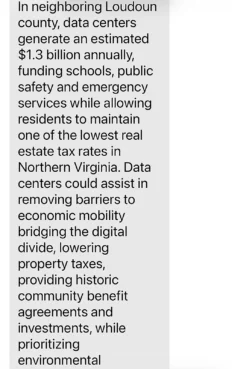
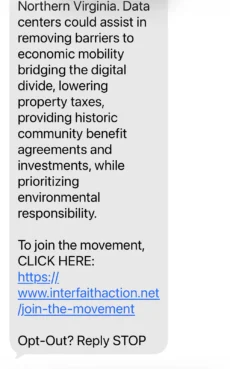
Dan Smith, członek Cheverly United Methodist Church i wolontariusz w Prince George’s County Civic and Environmental Alliance, powiedział, że odczuł „oburzenie” po zobaczeniu tekstu. Stwierdził, że wygląda to na „dobrze sfinansowaną akcję, która ma na celu zniekształcenie poglądów społeczności i stworzenie wrażenia, że istnieje poparcie — by dać poparcie tym wybranym urzędnikom, zwłaszcza na poziomie hrabstwa, którzy są zwolennikami centrów danych.”
Chociaż strona internetowa, do której odsyła wiadomość, nie identyfikuje grupy stojącej za nią, pod tym adresem widnieją strony identyfikujące grupę jako Interfaith Action Movement, „koalicję liderów duchowych, służących duchowym, społecznym i ekonomicznym potrzebom społeczności wykluczanych i marginalizowanych”, według samej strony.
Polityka prywatności strony określa IAM jako koalicję organizacji duchownych z siedzibą w New Jersey, będącą organizacją non-profit 501(c)(3), i podaje adres e-mail powiązany z organizacją kierowaną przez Greena, starszego duchownego w Kościele Adwentystów Dnia Siódmego i konsultanta politycznego.
Reached by phone by RNS, Green said that though he left to work as a senior adviser to New Jersey Democratic Gov. Phil Murphy, he’s been a longtime Prince George’s County resident. The IRS has record of his organization registered in Vincentown, New Jersey, for tax years that began in 2020 and ended in 2024.
Green said that IAM is a “policy think tank and advocacy organization” and that his policy team is working on a variety of issues, including affordable housing, mental health and child safety online.
He declined to name other faith leaders in his coalition, citing their privacy, though he said he works with Protestants, Muslims and Jews. He also declined to name his current congregation.
The political consultant and Seventh-day Adventist said he has led a daily prayer call since the beginning of the COVID-19 pandemic in March 2020, with faith leaders throughout the U.S.
“Faith leaders are some of the most impactful leaders in our nation,” Green said. “They absolutely have reached out to me, wanting to be educated on a number of issues that we are doing, including data centers.”
But the website that Prince George’s County residents learned about in the text focuses solely on data centers. Green shared another older website that focuses on child safety online and advocates for age verification and parental approval through the federal App Store Accountability Act.
Green cited high levels of phone use in his support for data centers. “We depend on data centers,” he said. “Mamy nadzieję stworzyć wokół tych centrów danych kulturę opartą na przejrzystości, otwartości, tworzeniu bogactwa, umowach o korzyściach dla społeczności (i) silnych standardach środowiskowych.”
He added, “The AI world takes us to a whole different frontier. How are Black and brown communities going to keep up?”
In 2022, Prince George’s County lost its decades-long title as the wealthiest majority Black county in the U.S. to neighboring Charles County.
Chociaż powiedział, że prowadził rozmowy z deweloperami centrów danych na temat swoich działań, Green stwierdził, że jeszcze nie rozmawiał z lokalnymi politykami o swoim poparciu dla korzyści ekonomicznych centrów danych.
Green odmówił odpowiedzi na pytania dotyczące finansowania swojej organizacji, w tym czy otrzymała pieniądze od deweloperów centrów danych.
Green has been linked to scandal in the past. Over a decade ago, he was involved in a campaign finance scandal in Bermuda that led to the resignation of the country’s premier in 2014. According to reporting by NorthJersey.com, Green set up a secret bank account holding $350,000 that U.S. businessmen had donated to the premier’s election efforts. Green and a business associate did not initially disclose these funds to party leaders. After the election, the new premier flew on one of the businessmen’s private jets to meet that businessman in Washington.
Two years ago, a judge dismissed Green’s attempt to sue New Jersey gubernatorial candidate Steve Fulop for $92,139 in alleged unpaid wages, as the campaign maintained he was a volunteer.
But Green has remained a force in New Jersey politics and was named to Gov. Mikie Sherrill’s interdisciplinary task force before she took office.
Green is currently a registered lobbyist for the city of Cambridge, Maryland, part of Dorchester County. But earlier this year, he was also a registered lobbyist for Prince George’s County, which is led by County Executive Aisha Braveboy.
In a questionnaire she submitted to the Baltimore Banner before winning her re-election primary, Braveboy wrote, “Data centers can play a role in Prince George’s County economic development, but only if they are planned responsibly and in partnership with our communities and not in residential areas.”
In the last year, Green has donated to various political campaigns inside and outside Prince George’s County, but his biggest donations by far are to Braveboy, totaling over $4,000. For those contributions, his home state is officially recorded as New Jersey.
Several online biographies from Green’s workplaces tout Green’s role in electing Democratic Maryland Gov. Wes Moore.
Moore’s and Braveboy’s offices did not respond when asked for comment about Green’s advocacy for data centers.
Despite the recent county moratorium on hyperscale data center development, Robin Lewis, director for climate equity at Interfaith Power & Light’s Washington, D.C., Maryland and Virginia branch, said it was written with “loopholes” that may allow data center development to move forward.
County council member Wanika Fisher submitted a zoning change that would allow for more data center construction in rural areas and will be reviewed by the planning board later this month — a development that worries Smith and other activists.
Lewis told RNS that a few people reached out to confirm her organization, which seeks to rally religious communities to address climate change, wasn’t behind the text. Interfaith Power & Light has submitted written and verbal testimony to the county council and participated in anti-data center rallies.
“We never do anything anonymously. We never would do anything like that,” the longtime Prince George’s County resident said. The group’s presence at rallies and testimony “demonstrates that we’re about the community, and what the community wants. And if the community is supporting moratoriums, we are supporting the community,” Lewis said.
Next month, her group will hold a webinar to organize against data centers, and it already has over 70 registrants across the larger region, she said. Interfaith Power & Light has also organized a “photo petition” where faith-based congregation members hold signs calling for community decision making around data centers.
“The faith community has always stepped in the gap, when it came to social justice issues, when it came to environmental justice issues, they’ve always stood up for the least of these,” Lewis said. She said she’s heard from faith leaders concerned about rising energy bills associated with data centers and increased pollution in places that already have high environmental burdens, often called “sacrifice zones.”
Lewis said her own pastors at Beloved Community Church, a United Church of Christ congregation, have expressed concern about data centers. Beyond that, she said, “I’m very connected in the Black church, and I know everybody is concerned with data centers.”
The text message compared Prince George’s County to neighboring Virginia’s Loudoun County, touting economic benefits from data centers in the latter. Lewis called the comparison “very ridiculous,” citing different demographics between the two counties and a higher density and level of preexisting pollutants in Prince George’s County.
In Prince George’s County, over 60% of residents are Black, compared to less than 9% in Loudoun County, and it has a median household income of slightly over $100,000, compared to slightly over $180,000 in Loudoun County.
“Faith leaders are residents. They live here. And the majority of residents in the county don’t support data centers,” Lewis said of Prince George’s County.